Almost every time someone lies down for their first session, they look up at me and ask, plainly, "Okay, but how does this actually work?" I love that question. It's a fair one to ask, and it deserves a real answer, because there's a lot of language in the wellness world that promises a lot and explains very little.
So here's how I'd answer, the same way I would if you were right here in front of me. Sound healing works by creating the conditions for your own body to heal itself. I'm not working some magic on you, and the healing doesn't come from me. I'm using sound and vibration to help your nervous system feel safe enough to relax, and from that place, your body can finally settle, restore, and come back into balance.
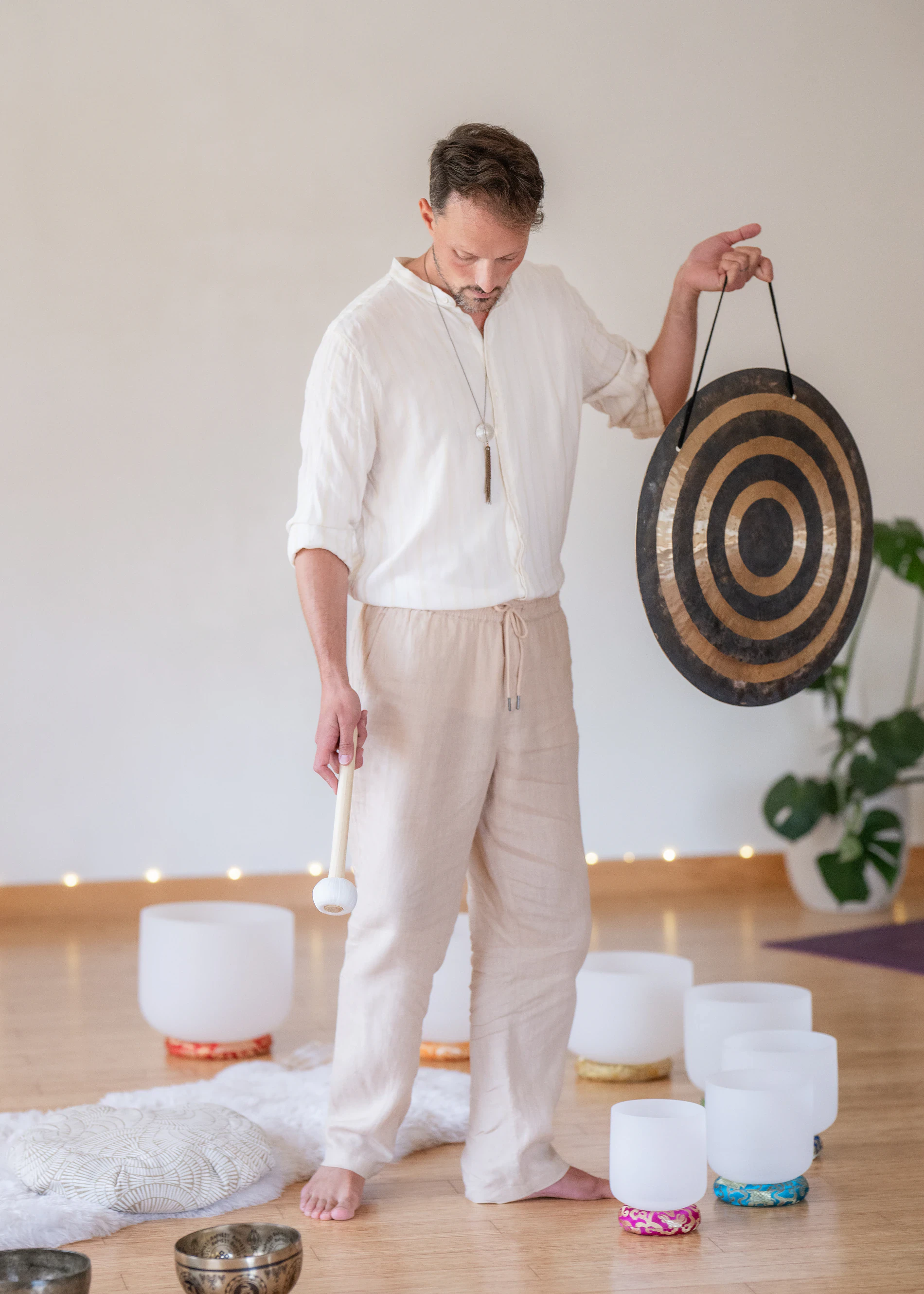
If you've never experienced one, the shape of a session is simple. You lie down, close your eyes, and let yourself settle while I play a range of instruments around you, and sometimes rest them gently on your body: crystal singing bowls, Himalayan singing bowls, tuning forks, gongs, chimes, and my own voice. During this time, there's nothing you need to do, and no way for you to get it wrong. You simply listen and let the sound move through you. In its simplest form it's a meditation guided by sound, which is why I often call it a sound meditation.
How Sound Healing Works in the Body
There's nothing mystical about how sound healing works. It comes from the way your body and brain are actually built, and there's real, growing science behind each piece.
You Feel Sound, and Your Body Tunes to It
Sound is vibration, a wave of energy moving through the air and into you. We tend to think of it as something we only hear, but your whole body is built to receive it. Your skin senses it, your bones carry it, and because you're mostly water, it travels easily through your tissue. This is why, when a gong is played up close to you, you feel it in your chest before you've formed a single thought about it.
From there, two simple principles explain how that vibration shifts you. The first is resonance. Every object has a natural frequency it tends to vibrate at, and when a strong, steady tone matches that frequency, the object begins to vibrate along with it. You can hear it when one struck tuning fork wakes its twin across the room. Your body responds the same way. The pure, sustained tones of the bowls and gongs give it coherent frequencies to vibrate in sympathy with, instead of the jagged, clashing sound most of us absorb all day.
The second principle is entrainment, the body's natural tendency to sync up with a steady rhythm around it. You already know the feeling. When a song with a strong beat comes on, your foot starts tapping in time before you've decided to. Your inner rhythms work the same way. The sound I offer is slow and unhurried, so your breathing lengthens, your heartbeat eases, and your busy mind begins to slow to meet it. You might arrive scattered and tense, and over the session your whole system finds its way toward something steadier. This is physics, not suggestion, and it's a big part of why the calm goes so deep.
It Settles Your Nervous System
Your nervous system has two main settings. One is the sympathetic state, your fight-or-flight response, which speeds you up and keeps you scanning for threats. The other is the parasympathetic state, often called rest-and-digest, where the body slows down, repairs, and lets its guard down. Modern life keeps many of us stuck in that first gear, braced for danger that isn't actually there.
Sound offers a way back into the parasympathetic state. It gives your system something steady and unthreatening to settle into. This isn't only a feeling. When researchers measure what happens during sound sessions, heart rate slows, blood pressure can drop, and cortisol, the body's main stress hormone, comes down.
Much of that calming happens through the vagus nerve, the longest cranial nerve and the main pathway of your parasympathetic system. It runs from your brainstem down through your throat and chest into your belly, and it largely sets how easily you move from stress back into rest. Sound reaches it in two ways. As the steady tones quiet your whole system, the vagus is the pathway that carries you down into rest. And when I invite humming or gentle chanting into a session, your own voice does something more direct: the vibration stimulates the vagus right where it runs through your throat. Both build what's called vagal tone, the responsiveness of that nerve. The stronger and more responsive it is, the more easily you recover from stress, and researchers can track it through heart rate variability, which humming and chanting have been shown to improve.
It Shifts Your Brain, and Recharges You
As you move through a busy day, thinking and solving and reacting, your brain hums along in a fast, alert rhythm called beta. It's the state most of us live in for nearly all of our waking hours. Through that same principle of entrainment, sound gently slows that rhythm into the calmer alpha and theta states, where the body rests and restores itself. Your brain is also a pattern-seeking machine, always working to make sense of the sound around it. The drifting, overlapping tones of a session give it almost nothing to decode, so the busy, analytical mind can finally stand down.
Although it isn't only about slowing down. In my experience, the high, overtone-rich tones of crystal and metal bowls leave people energized rather than drained, which is why so many walk out deeply rested and clear at the same time, feeling settled and wide awake. Those slow, open brain states are also where insight tends to surface, so people often leave more creatively open as well, with thoughts that had felt stuck starting to move again.
What It Looks Like in a Session
After a few years of this work, I get to watch it unfold almost every time. There's usually a visible release of muscular tension, and the breath slows and deepens on its own. Some people shake, yawn, or cry partway through, not from sadness, but because once they finally soften, something they had been holding onto finally has room to move. They let it pass through them, and they leave lighter than when they arrived.
There's one experience that has stayed with me. Someone came to me after a traumatic event they had experienced. They no longer felt safe in their body, and it showed up as anxiety and involuntary shaking they couldn't control. We went slowly, and when I rested a Himalayan singing bowl gently on their chest, the shaking stopped. Right away. It showed me how directly sound can reach a nervous system that's simply looking for safety. Placing instruments on the body that way is something I do with intention, and there's good research behind focused vibration for easing chronic pain too. None of this asks for any experience on your part. In one study out of UC San Diego, even people completely new to sound meditation showed a measurable drop in tension after a single session.
What People Tend to Notice
I want to be careful here, because the research is still in its early days and I never want to overpromise. But between what the research shows and what I see in the room, a few things come up again and again.
The most reliable is relief from stress and anxiety. People leave calmer, and those who come regularly often feel less on edge in their daily lives. Many sleep more deeply that night, sometimes for several nights after. Because the body finally drops into the state where it repairs itself, tightly held muscles begin to release, and the tension headaches that ride along with them often ease as well.
Sound also seems to change the way pain registers. People carrying long-held aches, including nerve pain, often tell me it feels quieter or more distant after a session. That's because a nervous system that feels safe meets pain differently, and that shift alone can bring real relief.
What Sound Healing Is, and What It Isn't
This is where I part ways with a lot of the language in my field. I don't think of what I do as raising your vibration or cleansing your aura. That has never aligned with what I actually offer, which is grounded in how the body and brain genuinely work.
The way I think about it, sound healing is a deeply meditative practice, and it happens to be far more accessible than sitting in silence. The sound gives your attention something to rest on, so you can practice staying present with whatever arises without grabbing onto it or pushing it away. That practice matters more than it seems. Each time you meet a thought or a feeling with that kind of equanimity, your nervous system learns that it's safe to soften, and over time that is what reshapes how you meet stress in the rest of your life. So the healing is in what your own system learns to do. Sound is simply the means that helps you get there, and practiced consistently over time, it can create real, lasting change.
I'll also say this plainly. Sound healing is a complement to good care, not a replacement for it. It works alongside medical and mental health support, never in place of it.
What I'd Love You to Know Before You Come
There's one thing that tends to surprise people: this isn't a passive practice. I can fill the room with sound and hold the space for you, but the shift happens through you, not to you. When you keep returning your attention to the sound, you stay in the present moment, and that steady returning is what lets your nervous system settle. Drift off completely and the sound becomes pleasant background. Stay with it, and it can genuinely move something in you. That same attention tends to follow you after a session, into how you listen to yourself and to the world around you.
So I'm not a healer in the usual sense of the word. I'm a facilitator, a deeply caring one. My role is to create a space where you feel safe enough to lower your guard and open to the sound. From there, the sound does its work, and your own system does the healing. What I bring you is simply an invitation: to lie down, to listen deeply, and to give your system the space it needs to find its way back into balance.